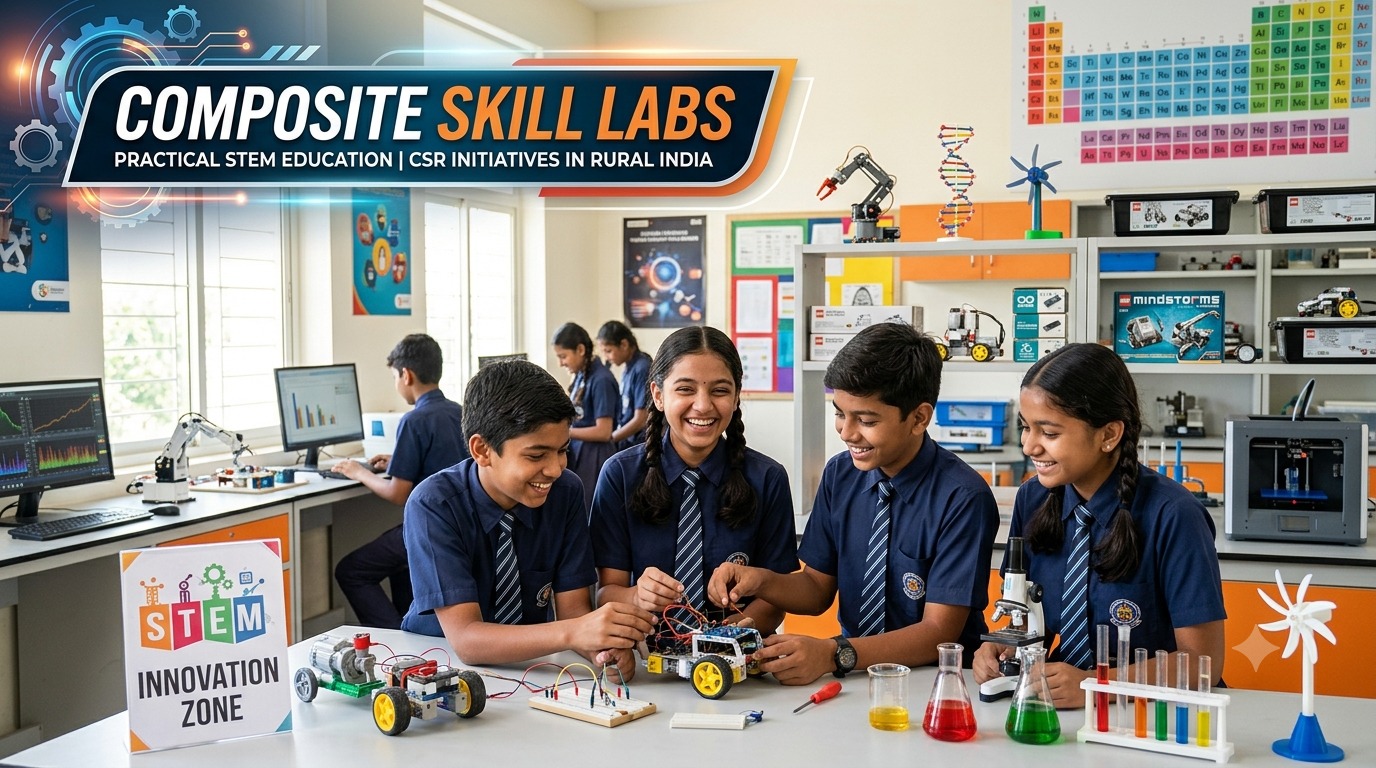
How can CSR funds be used to set up sustainable composite skill labs in rural schools?
Setting up Composite Skill Lab in rural schools through CSR funds can enable access to experiential and vocational education. Rural schools tend to lag behind in providing practical STEM and vocational education that Composite Skill Labs can help bridge the gap for. India's National Education Policy 2020 also promotes experiential and vocational education and encourages setting up skill labs in schools.
3 factors for sustainable skill labs
1. Going beyond infrastructure
A sustainable Composite Skill Lab in rural schools requires more than just setting up infrastructure and procuring equipment. CSR funding for Composite Skill Labs in rural schools must account for electricity, wifi, maintenance, learning resources, and the ability of the school to utilize the lab for regular learning. In turn, CSR funding for schools in rural areas becomes an investment in an active learning ecosystem rather than just a physical space.
2. Teacher & student training
The investment goes beyond just setting up infrastructure and equipment in rural schools. Teacher and student training, activities and projects that use the lab regularly, and conducting skill sessions can maximize the utilization of a Composite Skill Lab in rural schools. It directly ties into the government's push for vocational education and experiential learning through skill labs.
3. Long-term sustainability
While questions around how CSR funds can support Composite Skill Labs in rural schools are important, there are questions about what happens to the lab after its installation. A long term sustainability plan can ensure that the lab created with CSR funds continues to have an impact well after its installation. This could involve upgrading equipment, teacher training, monitoring and evaluation, maintaining the lab, and other activities. In other words, funding such a model would transform CSR funds from being just an infrastructure creation tool to a mechanism that creates long term impact by maximizing the utilization of a Composite Skill Lab in rural schools.
Science Utsav's Perspective
At Science Utsav, we believe that CSR funds for education should create opportunities for children to engage in experiential and vocational education in science, technology, robotics, electronics, and other similar fields. Well-planned Composite Skill Labs can help close the gap between privileged and underprivileged children when it comes to accessing opportunities in science and technology. For companies wondering how they can fund skill labs in rural schools, the focus should be on creating an end-to-end sustainable ecosystem that involves the right infrastructure, equipment, teacher training, and other activities.
How can composite skill labs benefit rural students? A well-planned Composite Skill Lab can provide students an opportunity to learn in a hands-on manner, conduct projects and experiments, and develop a number of valuable skills.
FAQs
1. Can CSR funds be used for school education?
Yes, as per Schedule VII of the Companies Act, promotion of education and employment-generating vocational skills is among the activities that fall under CSR.
2. What makes a composite skill lab sustainable?
The following were identified as key factors for sustainable labs: regular usage, teacher training, maintenance, appropriate equipment, and others.
3. Can CSR support STEM labs in rural schools?
Yes, as there already are several STEM labs in rural schools that were set up with the help of CSR funds. Some of these labs were set up with Science Utsav's help in government schools and rural schools in Karnataka.