Introduction
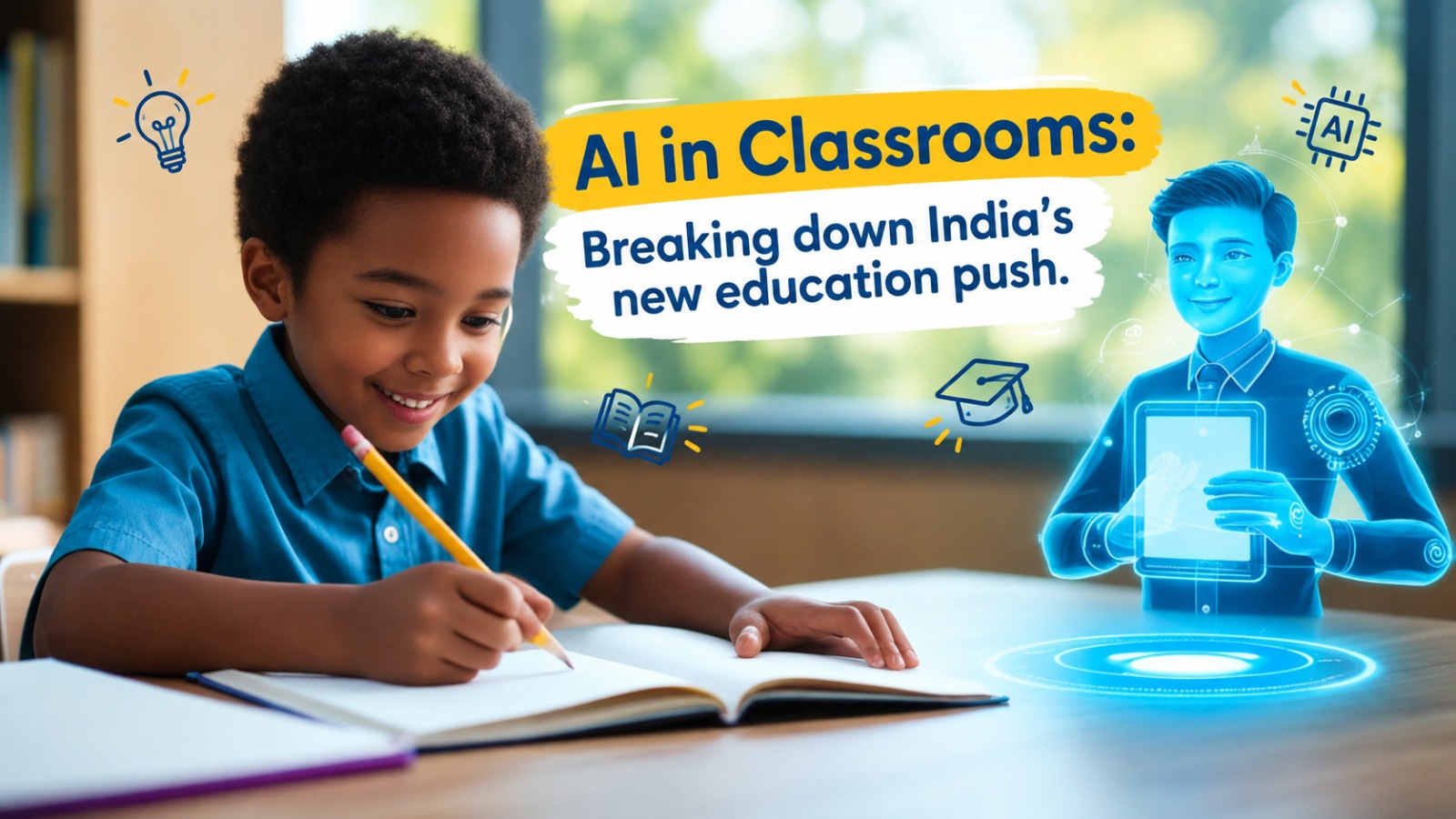
Artificial Intelligence is becoming less and less of something that students can only use in their future jobs. AI learning is being integrated into how children learn, explore, create and solve.
India's education system is no stranger to this, with the National Education Policy (NEP) 2020 already recognising technologies like AI, Machine Learning, adaptive learning and smart educational tools as a key priority area for the future of education.
What does AI mean for Indian classrooms?
It isn't simply about integrating an AI tool into each student's hands. It is about rethinking how students learn and how teachers can support them, through emerging technologies.
1. Personalised Learning
Every child learns differently. AI learning can provide personal explanations, practice questions, feedback and learning paths for each individual learner.
The Ministry of Education has also identified AI's potential for providing personalised assistance, regional language learning, translation, and home learning.
This is one of the largest benefits that AI presents to Indian education - that students can receive additional support without a one-size-fits-all approach in a classroom.
2. Teachers are AI-Enabled, Not Replaced
One of the largest myths surrounding AI in education is that technology will replace teachers.
In reality, effective AI education in India will involve a strong focus on teachers who understand when and how to use technology, with AI assisting them to provide students with mentorship, guidance and a human touch.
India is already investing in this direction, with SWAYAM Plus offering AI-focused training to enable educators to utilise AI for teaching and learning.
3. From Using Technology to Creating With It
The function of AI in the modern classroom needs to stretch beyond asking an AI chatbot for the answer.
Students need opportunities to question and understand AI, experiment with technology, and solve real world problems. The UNESCO AI competency framework similarly focuses on human-centred thinking, ethics, AI applications and system design.
That makes AI's transformation of Indian classrooms a much bigger conversation than just introducing new software. It is about how children learn critically, creatively, problem-solve and behave digitally.
ScienceUtsav's Perspective
At ScienceUtsav, we believe that technology will only offer its true value when children experience, build and experiment, rather than consume information.
Our approach to STEM learning is to integrate emerging technologies with hands-on activities, robotics, coding, design thinking and real-world problem-solving. This complements the increasing focus of education on AI, computational thinking and future-ready skills.
AI should become yet another tool for curiosity, not a shortcut around learning.
The future of AI in education in India will be about finding the right balance - technology that enables more personal and accessible learning, supported by teachers who enable students to think, question and create.
Conclusion
India's AI education push is more than just a technological upgrade. It speaks to the need to prepare students for a world where AI will be a part of almost every industry.
The largest opportunity that AI presents to Indian education is not simply teaching children to use AI tools for students and teachers. It is teaching them to use technology responsibly and think independently.
The classroom of tomorrow won't be human vs AI. It will be humans learning to work better with AI.
FAQs
1. Why is AI important in Indian education?
AI can support personalised learning, improve access to educational resources and help students develop future-ready digital and problem-solving skills.
2. What are the benefits of AI in classrooms?
Key benefits include personalised feedback, adaptive learning, interactive learning experiences and support for teachers.
3. Will AI replace teachers?
No. AI can support teaching, but teachers remain essential for mentorship, judgement, emotional support and meaningful classroom interaction. UNESCO also emphasises that AI should complement - not replace - the role of teachers.
4. How can children learn AI responsibly?
Children should learn AI alongside critical thinking, ethics, privacy, creativity and hands-on STEM activities rather than relying on AI for ready-made answers.